


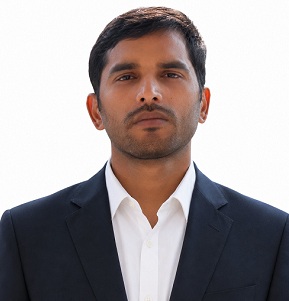
Mr. Ram Vikash
Assistant Professor
Mr. Ram Vikashis an Assistant Professor in the School of Engineering at Dayananda Sagar University, Bengaluru. He holds an M.Tech (Research) in Intelligent Systems from the Indian Institute of Technology (IIT) Mandi, where he worked as an HTRA Scholar in the School of Computing and Electrical Engineering.
His research focuses on Artificial Intelligence for Healthcare, with particular emphasis on Medical Image Analysis, Computer Vision, Deep Learning, and Medical Imaging. During his M.Tech (Research) at IIT Mandi, he worked on deep learning-based approaches for the automated segmentation of clinically significant prostate cancer lesions from MRI. His research addresses key challenges in medical image segmentation, including lesion localization, boundary preservation, and cross-dataset generalization, through the development of novel attention mechanisms and segmentation architectures.
His research contributions include an accepted paper at the 10th International Conference on Computer Vision & Image Processing (CVIP 2025). He has also submitted his research to the IEEE Winter Conference on Applications of Computer Vision (WACV) and the Computer Methods and Programs in Biomedicine (CMPB) journal.
His broader research interests include Generative AI, Large Language Models (LLMs), Multimodal Learning, Vision-Language Models (VLMs), and Transformer-based architectures. His research vision is centered on developing trustworthy, interpretable, and clinically applicable AI systems for disease detection, medical image segmentation, diagnosis, and treatment planning, with the aim of translating advanced AI research into meaningful healthcare applications.
Prior to joining IIT Mandi, he pursued postgraduate studies in Artificial Intelligence and Data Science at IIIT Bhagalpur. He completed his B.Tech in Electrical Engineering from BPUT University, Odisha, and has over 2.5 years of industrial experience at Gupta Power Infrastructure Limited, Bhubaneswar.
His academic and research vision is to bridge cutting-edge Artificial Intelligence research with real-world healthcare and industrial applications, contributing to the development of intelligent technologies that are reliable, explainable, and capable of supporting clinical decision-making.

- Home

- Prof. Ram Vikash


The future is intelligent. And it is being built at DSU. Be part of India's AI revolution.
About
Brochures
Admissions

DSU Main Campus:
- Devarakaggalahalli, Harohalli,
Kanakapura Road,
Bengaluru South Dt. – 562 112
E-mail: admissions@dsu.edu.in DSU City Innovation Campus:
- Administrative & Main Admission office,
Kudlu Gate, Hosur Road,
Bengaluru - 560 114
Admissions Helpline: 080 46461800 / 080 49092800 / +91 7760964277 / 8296316737 / 6366885507
E-mail: admissions@dsu.edu.in | dsat@dsu.edu.in - Office of Registrar: 080 4909 2910 / 11
Office of Dean (Engineering): +91 80 4909 2986 / 32 / 33
Dean - MBA: 080 4909 2931
Enquiry EMBA: 080 4909 2930
Research Cell: 080 4909 2912 DSU City Admissions Office:
- Gate 2, 6th Floor, University Building,
Dental Block, Kumaraswamy Layout,
Bengaluru - 560111
Admissions Helpline: 080 46461800 / 080 49092800 - E-mail: enquiry@dsu.edu.in / admissions@dsu.edu.in