


Best Practices of the Department
The Department of Computer Science & Technology follows a set of institutionalised best practices designed to strengthen student learning, research culture, innovation, and teaching quality. These practices are implemented systematically from the second year of the programme onwards and are reviewed periodically for continued relevance and impact.
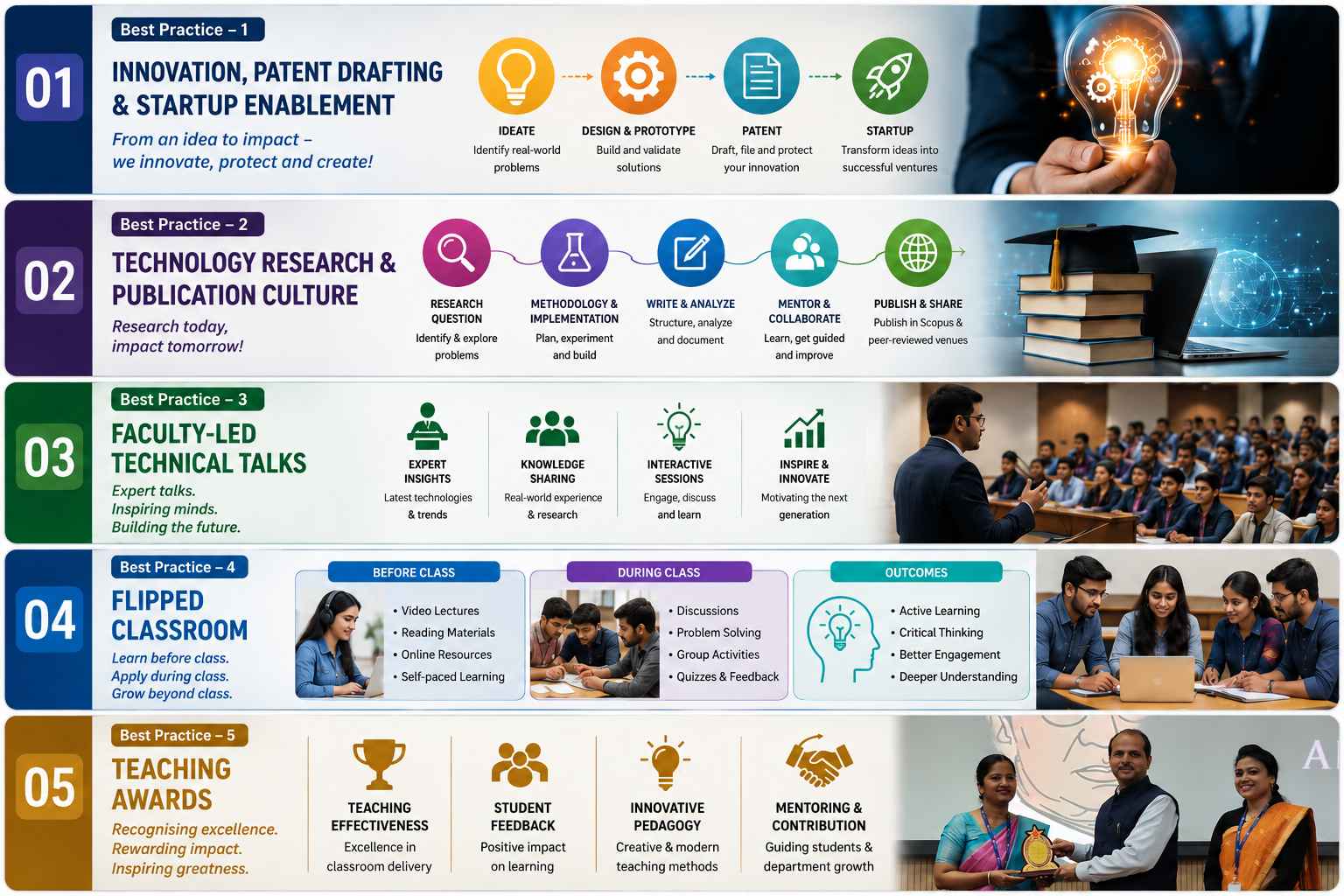
Best Practice – 1:Innovation, Patent Drafting and Startup Enablement
- Encourage undergraduate students to identify and develop patentable ideas through structured discussions.
- Build students' capabilities in ideation, brainstorming, and prototyping of real-world solutions.
- Provide hands-on guidance in patent drafting and filing.
- Support students in registering their innovations as IPR assets and, where viable, as startups.
- Implemented systematically from the second year of the programme onwards.
- Students begin with Design Thinking and Ideation workshops to identify real-world problems and develop innovative solutions.
- A design registration workshop is conducted to guide students in protecting their innovative designs.
- A dedicated patent drafting workshop provides hands-on guidance in preparing and filing patent applications.
- Students are supported in validating their ideas and developing prototypes for real-world applications.
- Value-added courses such as Lean Start-up Methodologies, Product Development, and Small E-Business Launch provide practical exposure to innovation and entrepreneurship.
- Viable student ideas are further supported for formal startup registration.
- The practices are periodically reviewed to ensure their continued relevance and impact.
- Students have drafted and published patents after identifying and validating real-life problems, with supporting proof maintained by the department.
- Several students have successfully registered startups after completing the workshop sequence.
- Students have completed field-based and real-life problem-oriented capstone projects, including award-winning and CSR-linked initiatives.
- Multiple patents have been published with application numbers on record.
- A documented list of student-led startup and patent projects is maintained by the department.
Innovation, Patent Drafting and Startup Enablement
Guiding students from idea generation through design registration, patent drafting, and eventual startup formation.
Objectives
The Context
The Department of Computer Science & Technology follows institutionalised best practices designed to strengthen student learning, research culture, innovation, and teaching quality. These practices are implemented systematically from the second year of the programme onwards and are reviewed periodically for continued relevance and impact. The CST curriculum is structured to prepare students for two complementary career paths: industry roles and innovation-led entrepreneurship. Value-added courses alone are not sufficient to build this capability; therefore, the department conducts dedicated Design Thinking and Ideation workshops that help students frame credible problem statements and develop solutions. A subsequent value-added course validates the effectiveness of these solutions for real-world use. Courses such as Lean Start-up Methodologies, Product Development, and Small E-Business Launch provide students with direct field exposure to identifying genuine problems and testing solutions, thereby creating a pathway from idea generation to patent and startup formation.
The Practices
Evidence of Success
Best Practice – 2 :Technology Research and Publication Culture
- Enable students to write research papers suitable for peer-reviewed journals.
- Build awareness of research ethics and academic integrity.
- Strengthen and continually upgrade creative and innovative research writing skills among students and faculty.
- Cultivate a strong research culture within the department.
- Refine student and faculty publishing skills over time.
- The practice begins in the second year with an orientation to research methodologies, types of research, and paper-writing conventions through Special Topics sessions.
- Students draft original research work under the guidance of faculty members.
- Students complete implementation-based assignments that contribute towards developing publishable research results.
- Mini-projects and capstone projects are converted into structured research papers with appropriate referencing.
- Students are guided on research ethics, academic integrity, and proper research practices.
- Students co-author research papers with faculty mentors to strengthen their research and publication skills.
- Research papers are submitted to Scopus-indexed journals, peer-reviewed journals, and conference proceedings.
- Students and faculty continuously enhance their creative, innovative, and academic research-writing skills through regular research and publication activities.
- Faculty members have consistently mentored students throughout the research-writing and publication process.
- A growing number of student-authored and co-authored research papers have been published in peer-reviewed and Scopus-indexed venues.
- Students have developed research and academic writing skills through mini-projects, capstone projects, and implementation-based assignments.
- The department has strengthened its research and publication culture through continued student and faculty participation in research activities.
Technology Research and Publication Culture
Building research writing and publication skills so students can address current technology problems and share their work with a global academic audience.
Objectives
The Context
As part of their coursework, students undertake mini-projects and capstone projects and are encouraged to translate this work into structured research papers with proper referencing. This process sharpens both the creativity of the student-writer and the objectivity expected by an academic audience. It also forms an essential bridge between classroom learning and the development of independent research capabilities. The Department of Computer Science & Technology promotes a strong research culture by providing students and faculty with opportunities to develop research, writing, and publication skills.
The Practices
Evidence of Success
Best Practice – 3 :Faculty-Led Technical Talks
- Promote continuous learning through structured knowledge sharing by faculty members.
- Keep students and faculty updated on emerging technologies, tools, and recent advancements.
- Encourage interdisciplinary learning and a collaborative academic culture within the department.
- Enhance the technical presentation, communication, and mentoring skills of faculty members.
- Motivate students towards innovation, research orientation, and professional growth.
- Faculty-Led Technical Talks are conducted regularly for students and fellow faculty members from the second year onwards.
- The sessions are aligned with curriculum requirements, emerging technologies, and ongoing research interests.
- Advanced topics beyond the prescribed syllabus are introduced to enhance students' technical knowledge.
- Sessions cover emerging technologies, tools, and recent advancements relevant to the field.
- Faculty members share research insights, case studies, and established best practices.
- Hands-on demonstrations and implementation-oriented concepts are included wherever appropriate.
- Sessions are conducted interactively, encouraging discussion, collaborative problem-solving, and open sharing of experiences.
- The talks also provide faculty members with opportunities to enhance their technical presentation, communication, and mentoring skills.
- Improved technical awareness and conceptual clarity among students.
- Stronger peer learning and interdisciplinary knowledge exchange among faculty members.
- Increased student interest in advanced projects, internships, and research activities.
- Greater faculty engagement in continuous professional development and knowledge sharing.
- Consistently positive participant feedback on the relevance of the sessions and the knowledge gained.
Faculty-Led Technical Talks
Strengthening technical competence and knowledge sharing through structured, faculty-driven sessions.
Objectives
The Context
Given the rapid pace of technological change, it is essential for both students and faculty to stay updated with emerging trends and recent advancements. Faculty members continuously develop domain expertise through teaching, research, certifications, and professional development activities. Faculty-Led Technical Talks provide an internal platform for sharing this expertise with students and fellow faculty members. These structured sessions enrich the curriculum, promote peer learning, encourage knowledge exchange, and help keep academic content aligned with industry and research requirements.
The Practices
Evidence of Success
Best Practice – 4 :Flipped Classroom
- Enhance student engagement through active and participative learning methods.
- Encourage self-paced and independent learning among students.
- Use classroom time more effectively for discussion, application, and problem-solving.
- Develop critical thinking, analytical, and collaborative skills.
- Optimise classroom interaction to deepen learning outcomes.
- The Flipped Classroom model is implemented across core and advanced courses from the second year onwards.
- Faculty members share recorded lectures, reading materials, presentations, notes, and problem statements before each session.
- Students undertake pre-class learning through videos, notes, online resources, and other relevant study materials.
- Classroom sessions focus on discussions, quizzes, problem-solving, case studies, and the application of concepts.
- Group activities and peer-learning exercises are facilitated by faculty members to encourage collaboration.
- Students are encouraged to actively participate, ask questions, and engage in collaborative problem-solving.
- Faculty provide continuous feedback and clarify difficult concepts during classroom sessions.
- The approach gives faculty more time to mentor, guide, and reinforce complex and application-oriented concepts.
- Increased student participation and engagement during classroom sessions.
- Better understanding of complex and application-oriented topics.
- Stronger critical thinking, communication, and teamwork skills among students.
- Improved academic performance and overall learning outcomes.
- Positive student feedback on the effectiveness, flexibility, and interactive nature of the approach.
Flipped Classroom
Promoting active learning and student-centric teaching by moving content delivery outside the classroom.
Objectives
The Context
Conventional lecture-based teaching often limits opportunities for real-time interaction, discussion, and higher-order thinking during classroom hours. The Flipped Classroom model addresses this by shifting basic content delivery outside the classroom, allowing classroom time to be devoted to active and application-oriented learning. Students receive learning materials in advance and come prepared for meaningful discussions, collaborative activities, problem-solving, and concept clarification. This approach promotes outcome-based and student-centric education while enabling students to take greater responsibility for their own learning.
The Practices
Evidence of Success
Best Practice – 5 :Teaching Awards
- Recognise and reward excellence in teaching and academic commitment among faculty members.
- Motivate faculty members to adopt innovative and student-centric teaching methodologies.
- Promote continuous professional development and pedagogical improvement.
- Enhance the overall quality of the teaching-learning process.
- Foster a culture of academic excellence, accountability, and healthy competition within the department.
- Teaching Awards are conferred through a structured process to recognise outstanding teaching performance among faculty members.
- Faculty performance is assessed based on predefined criteria, including teaching effectiveness, student feedback, and academic performance indicators.
- Innovative teaching methodologies, student-centric practices, and the effective use of ICT tools are considered during the evaluation process.
- Curriculum enrichment activities, mentoring outcomes, and broader professional contributions are also taken into account.
- Outstanding faculty members are recognised during departmental or institutional academic events.
- Award recipients are encouraged to share their successful teaching practices and innovative approaches with fellow faculty members.
- The practice motivates faculty members to continuously improve their pedagogical skills and adopt effective teaching-learning strategies.
- Increased faculty motivation and engagement in teaching innovation.
- Wider adoption of student-centric and outcome-based teaching methodologies.
- Improved teaching quality and greater student satisfaction.
- A stronger academic culture of professional accountability and continuous improvement.
- Positive impact on student learning outcomes and overall academic performance.
Teaching Awards
Recognising and encouraging excellence in teaching among department faculty.
Objectives
The Context
Quality teaching is central to achieving academic excellence and strong student learning outcomes. Recognising faculty efforts through Teaching Awards encourages innovation, dedication, and sustained commitment to effective teaching practices. Such recognition motivates award recipients while also inspiring other faculty members to improve their teaching performance. The practice contributes to strengthening the department's overall teaching-learning ecosystem and promotes a culture of continuous improvement, professional accountability, and academic excellence.
